along with company name.png)
A bag of coffee beans, a smartphone, and a cotton T-shirt all have one thing in common when they cross a border. They carry a short number that tells customs officers exactly what they are, in any country and any language. That number is the HS code, and getting it right can be the difference between a smooth shipment and a costly delay.
What Is an HS Code?
HS stands for the Harmonized Commodity Description and Coding System, usually shortened to the Harmonized System. Think of it as a universal dictionary for products, where every item has its own numeric entry.
It is developed and maintained by the World Customs Organization (WCO) and has been in force since 1 January 1988. Today, more than 200 countries and economies use it, covering over 98% of goods traded worldwide. In India, you'll often hear it called the HSN code (Harmonized System of Nomenclature), but it's the same system.
How an HS Code Is Built
The system is organised like a family tree, with 21 sections, 97 chapters, about 1,200 headings and over 5,600 subheadings in the HS 2022 edition. Each pair of digits narrows the product down a little further:
- First 2 digits: the chapter (broad category)
- First 4 digits: the heading (product group)
- All 6 digits: the subheading (specific product)
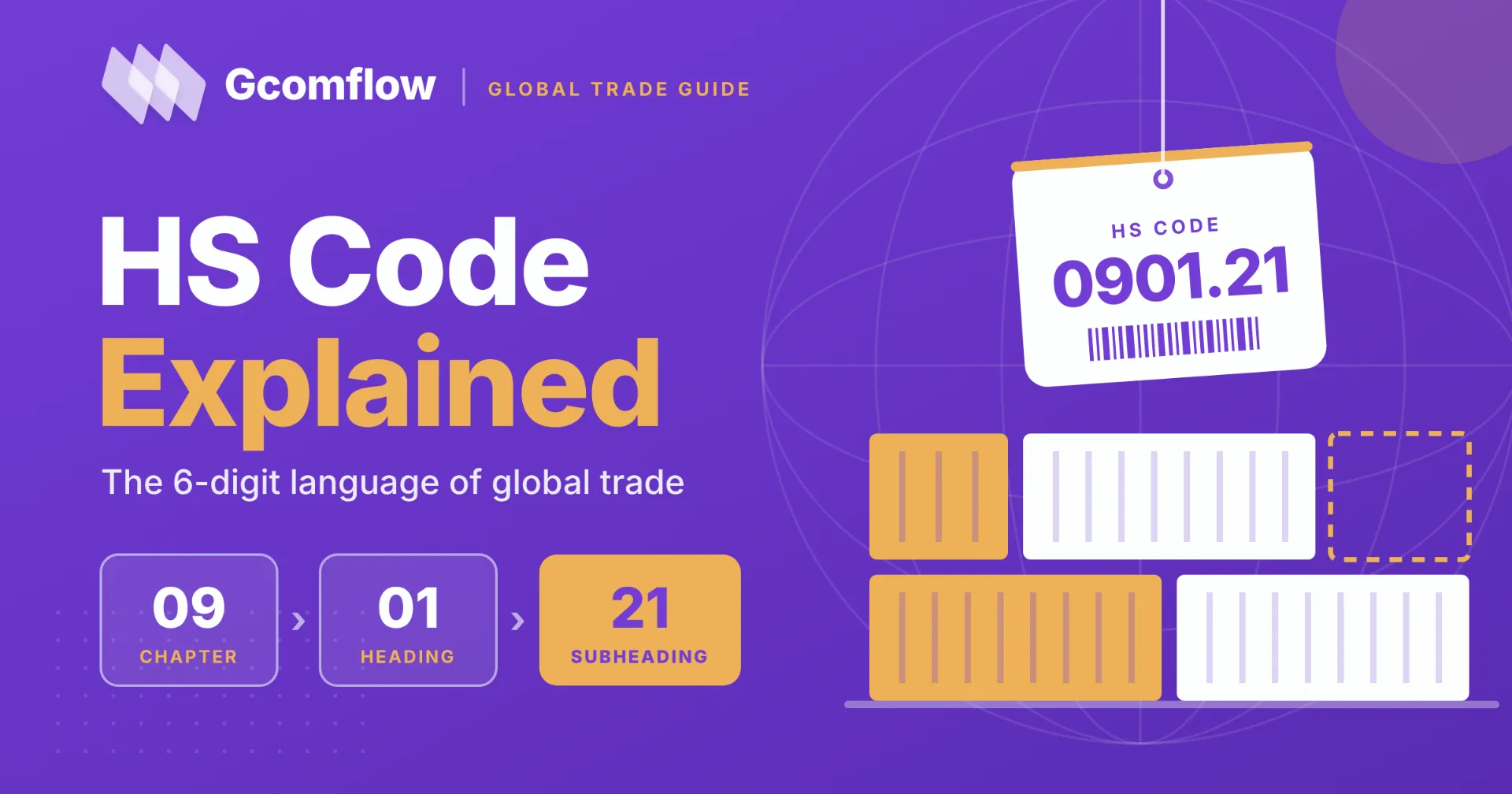
Take roasted coffee as an example. Chapter 09 covers coffee, tea, maté and spices. Heading 0901 narrows it to coffee, and subheading 0901.21 pins it down to coffee that is roasted and not decaffeinated. These first six digits are identical in every member country, which is what makes the system truly global.
Why HS Codes Matter for Your Business
An HS code isn't just a label for paperwork. It quietly controls several things that hit your costs and timelines directly:
- Customs duty: the code decides the tariff rate you pay at the border.
- Rules and restrictions: licences, quotas, anti-dumping duties and banned items are all linked to HS codes.
- Free trade agreements: rules of origin are written by HS code, so the right code unlocks lower or zero duty.
- Faster clearance: accurate codes mean fewer queries, inspections and holds at the port.
Governments also use HS codes to track trade statistics, and in India, HSN codes appear on GST invoices too.
Beyond Six Digits: National Codes
The global six digits are only the starting point. Most countries add their own digits on top to set local duty rates and trade policies:
- India: 8-digit ITC-HS codes, used by DGFT for trade policy and by Customs for tariffs.
- United States: 10-digit HTS codes for imports and Schedule B codes for exports.
- European Union: 8-digit Combined Nomenclature (CN), extended to 10 digits in TARIC.
So while the first six digits travel with your product, always use the destination country's full code when importing.
How to Find the Right HS Code
Classification can feel tricky at first, but a methodical approach makes it much easier. Start by describing your product precisely: what it's made of, what it does, its form and how it's used. Then work top-down, picking the chapter first, then the heading, then the subheading.
- Follow the General Rules of Interpretation (GRIs): the WCO's six rules that settle classification when a product could fit more than one place.
- Check official tariff tools: CBIC and ICEGATE in India, the USITC HTS search in the US, and TARIC in the EU.
- Get an advance ruling when unsure: CAAR in India, a CBP binding ruling in the US, or Binding Tariff Information (BTI) in the EU.
For complex or high-value products, a licensed customs broker or freight forwarder can confirm the code before you ship.
Common HS Code Mistakes to Avoid
Most classification errors come from small shortcuts. Watch out for these:
- Guessing from the product name: a "smart watch" and a "fitness band" may not share a code.
- Copying the supplier's code blindly: their national digits may not match your country's tariff.
- Using outdated codes: codes change with every HS revision.
- Inconsistent paperwork: the invoice, packing list and shipping bill should all show the same code.
The cost of getting it wrong adds up quickly: penalties, short-paid duty demands with interest, shipments held at port and lost FTA benefits.
What's Next: HS 2028
The WCO reviews the Harmonized System roughly every five years to keep pace with new products and shifting trade patterns. The current edition, HS 2022, brought 351 sets of amendments, including new codes for items like drones and e-waste.
The next edition, HS 2028, takes effect on 1 January 2028. If you trade regularly, now is a good time to review your product codes and get ahead of the change.
Final Thoughts
An HS code may look like a small string of digits, but it shapes what you pay, how fast your goods move and which trade benefits you can claim. Take the time to classify each product carefully, keep your codes up to date, and lean on experts when a product doesn't fit neatly. Your shipments, and your margins, will thank you.