along with company name.png)
What Is a Let Export Order (LEO) in Customs?
Let Export Order (LEO) is the formal permission Indian Customs grants to load goods for export. The full form of LEO in export is "Let Export Order", and it is issued by the proper officer of Customs under Section 51 of the Customs Act, 1962 once the Shipping Bill has been assessed and, where required, the cargo has been examined.
In simple terms, LEO is your customs clearance for export. Until the LEO is granted, goods cannot be loaded onto a vessel, aircraft or courier consignment, and cannot legally leave India.
Why the LEO Date Matters for Exporters
The LEO date is treated as your date of export for customs purposes, so several outcomes depend on it:
- Export duty and exchange rate. Under Section 16 of the Customs Act, export duty (where applicable) and the customs exchange rate are applied as on the LEO date.
- Export incentives and refunds. Duty drawback, RoDTEP credits and IGST refund on exports are processed only after LEO is granted and the carrier's Export General Manifest (EGM) is filed.
- Proof of export. The LEO-endorsed Shipping Bill is the document your bank, auditor and GST officer ask for when you claim zero-rated supply or reconcile export proceeds.
- Shipment timelines. No LEO means no loading, which can mean a missed vessel cut-off or flight, plus extra port and storage charges.
How to Get a Let Export Order: Step-by-Step LEO Process
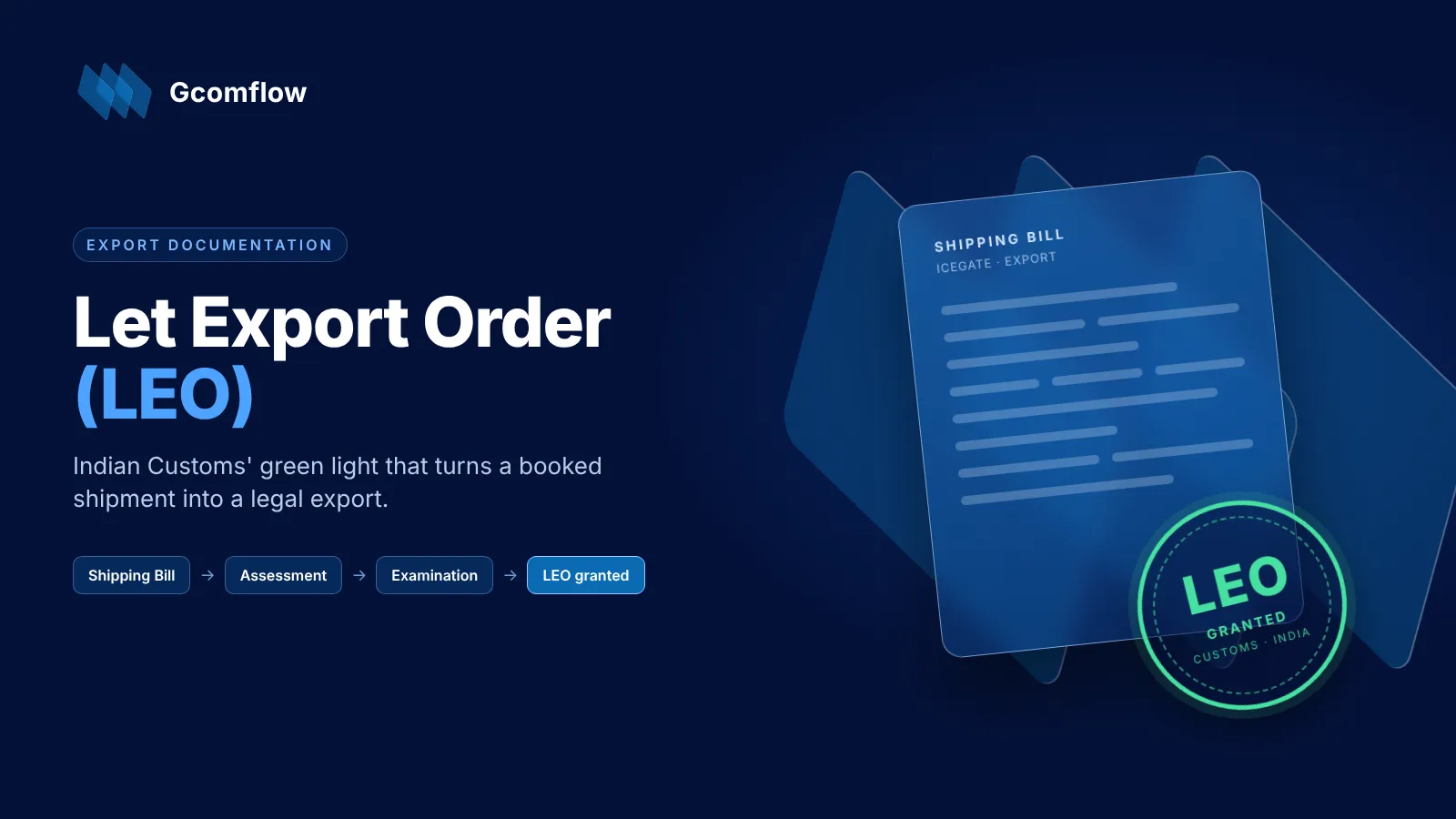
- File the Shipping Bill on ICEGATE. The exporter or customs broker files the Shipping Bill electronically with the commercial invoice, packing list, HS codes and export scheme details.
- Bring the goods to the customs area. Cargo is carted into the port, ICD, CFS, air cargo terminal or courier terminal and registered against the Shipping Bill.
- Customs assessment. The Risk Management System (RMS) either facilitates the shipment or routes it to an officer for assessment.
- Physical examination, if selected. Customs may open and verify the cargo against the declared description, quantity and value.
- LEO granted. The officer issues the Let Export Order. The LEO status updates on ICEGATE, and the LEO copy can be downloaded and printed.
- Loading and EGM filing. Goods are loaded, the shipping line or airline files the EGM, and incentive and refund claims move forward.
Frequently Asked Questions About LEO
What is the full form of LEO in export?
LEO stands for Let Export Order. It is the customs permission that allows goods to be loaded for export from India.
Who issues the Let Export Order?
The proper officer of Indian Customs issues the LEO under Section 51 of the Customs Act, 1962, after assessment and any required examination of the goods.
How do I check LEO status and download the LEO copy?
Track your Shipping Bill on the ICEGATE portal using the port code, Shipping Bill number and date. Once Customs grants the LEO, the status updates and the LEO copy can be downloaded.
Is the LEO date the same as the date of export?
For customs purposes, yes. The export duty rate and exchange rate are applied as on the LEO date, and it is widely used as the date of export.
Can goods be loaded before LEO is granted?
No. Goods can be loaded onto a vessel or aircraft only after the Let Export Order is issued.
Is LEO required for courier and e-commerce exports?
Yes. Courier exports, including e-commerce shipments, are filed on a Courier Shipping Bill and also need customs clearance before they are dispatched.
Conclusion: Get Your LEO Faster with Gcomflow
The Let Export Order is the green light that turns a booked shipment into a legal export, and the LEO date drives your duty, refunds and incentives. Accurate Shipping Bills, correct HS codes and early planning are what get LEO granted quickly.
At Gcomflow, we help exporters keep their export documentation accurate and their shipments moving, so LEO is a formality rather than a bottleneck. Talk to the Gcomflow team to simplify your export clearance.